The short answer
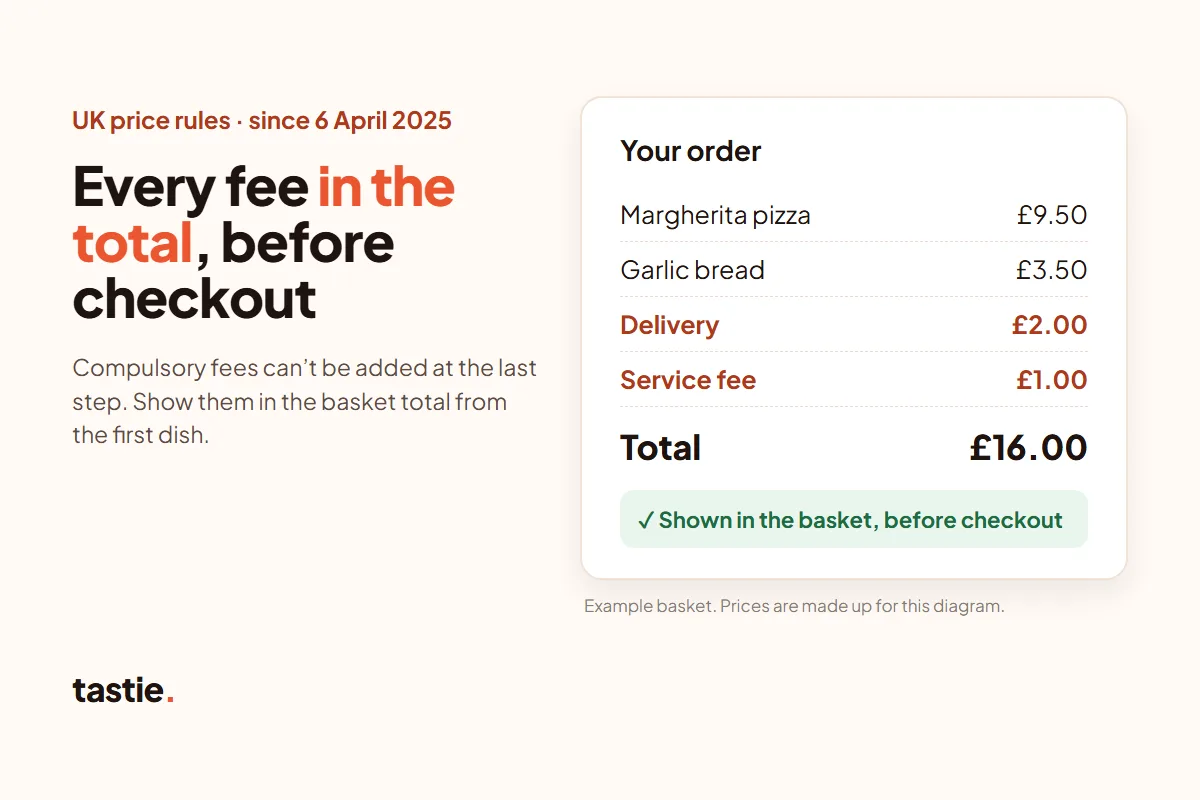
Yes. A takeaway can charge a delivery fee or a service fee, or set a minimum order, as long as customers can see every compulsory charge before they order. Since 6 April 2025, the Digital Markets, Competition and Consumers Act 2024 has made it illegal to hide compulsory fees until checkout. This is called drip pricing.
Be careful with the name. A “service charge” for your staff’s service is treated like a tip under the Employment (Allocation of Tips) Act 2023, and must go to your staff in full. A fee that pays for something else, such as the ordering website, is a different thing, so say clearly what it is for.
What is drip pricing, and what changed in April 2025?
Drip pricing is showing one price and adding compulsory fees later in the order. GOV.UK’s summary of the CMA’s guidance puts it plainly: “It’s illegal to hide additional fees, taxes or other charges that the customer will have to pay until later in the purchase process.” GOV.UK summary ↗
The rule is in section 230 of the Digital Markets, Competition and Consumers Act 2024 ↗, which came into force on 6 April 2025 and replaced the Consumer Protection from Unfair Trading Regulations 2008. When you show customers food and its price in a way that lets them buy, the price must be the total price, including “any fees, taxes, charges or other payments” they will necessarily pay. If part of the price can’t be worked out in advance, such as delivery to an address you don’t know yet, you must say how it is worked out.
The CMA’s guidance for businesses, Price transparency (CMA209) ↗, was published on 18 November 2025 and explains how to apply the rule.
Can a takeaway charge a service fee?
Yes. But if every customer has to pay it, it is a compulsory (“mandatory”) charge and must be part of the price you show. The CMA’s list of mandatory charges includes administration fees “however described”, such as booking or processing fees and platform charges, and “mandatory cover or service charges at a restaurant”.
Calling a fee an extra doesn’t make it optional. The CMA says that showing a charge separately from the headline price, or describing it as an extra service, does not make it optional: if the customer has to pay it to get the food, it is mandatory. Only a genuinely optional extra can be left out of the total price.
How should fees be shown on an online menu?
A per-order fee can’t sensibly be added to the price of every dish, because the customer only pays it once. For orders of several items, the CMA’s guidance allows another way: show the dish prices, explain the fee, and keep a clear running total that includes it as the customer adds food (paragraphs 5.17 to 5.20).
Its own example is a food delivery app. The delivery charge is shown on the restaurant list and again on the menu, and the running total includes it from the first item. The CMA adds that if the restaurant or platform has any other mandatory charges, they should be clear and visible from the start and included in that running total.
A two-minute check: open your own ordering page on your phone, add one dish and look at the total. Every compulsory fee should already be in it, before the checkout page.
On a printed menu or leaflet, say clearly near the prices that the fee applies to every order, so customers can work out what they will pay. The CMA says per-order charges should always be shown, and included in the total price wherever possible.
Is a service fee the same as a service charge?
Not necessarily, and the difference decides who gets the money. Under the Employment (Allocation of Tips) Act 2023 ↗, in force since 1 October 2024, employers must pass all tips, gratuities and service charges to their workers in full, without deductions apart from things like income tax. They must also share them fairly, pay them by the end of the month after the customer paid, and keep a written tipping policy.
The Act covers money a customer pays “by way of a tip, gratuity or service charge (however described)”. So the label doesn’t decide it. If customers pay a charge as a tip, or for the service your staff give them, it is likely to be covered even if you call it a “service fee”. A fee that pays for something else, such as an ordering platform, is a different thing, but say clearly what it is for so customers don’t mistake it for a tip.
The government’s code of practice on distributing tips ↗ explains the rules, including tips paid by card. It is being revised after the Employment Rights Act 2025, so check GOV.UK for the current version.
What are the rules for delivery fees?
- Show it before checkout. If delivery is the only way to get the food, the delivery fee is a mandatory charge and belongs in the total price. If customers can choose collection instead, the delivery fee is optional, but GOV.UK’s summary says optional delivery charges must still be shown when you show the price.
- Fees that change by distance or postcode. Explain how the fee is worked out, as clearly as the food prices, so customers can work out the total themselves. Once they have entered their address, include the right fee in the total.
- “Free delivery over £20”. The CMA says to include the full delivery fee in the total until the basket reaches the threshold, and to say what delivery costs below it. Advertising free delivery over a set amount without saying what it costs below that may be a misleading omission.
Can you set a minimum order?
Yes. Nothing stops a takeaway from setting a minimum order for delivery. The CMA’s guidance says that where delivery is only available above a certain order value, the business should make customers aware of the minimum and help them see their total, for example with a running basket total (paragraph 5.16).
Show the minimum on your menu page, not only as an error message at checkout. If it changes by area, say so where customers enter their postcode.
Do you charge VAT on delivery charges?
Only if your business is VAT-registered. HMRC treats delivering hot, ready-to-eat food as catering, which is standard-rated (VAT Notice 709/1 ↗). For delivery charges, HMRC’s rule is that where delivery is part of the deal, “An additional charge for delivery will follow the liability of the goods” (VAT Notice 700/24, section 2.2 ↗). So a delivery charge on a hot food order is normally standard-rated too.
HMRC also says a service charge you add is standard-rated, but no VAT is due on a tip a customer freely gives on top of your total. Orders that mix hot food with zero-rated cold food are more complicated, so ask your accountant.
How does tastie. show its £1 service fee?
Customers pay just a £1 service fee per order, whatever the order size. That £1 is how tastie. is paid. On a tastie. ordering website it appears as its own line in the basket and is included in the total the customer sees before they check out.
It pays for the ordering service, not for your staff’s service, so we call it a service fee and never a service charge. Your takeaway pays 0% commission, no set-up fee and no monthly fee. Card orders have a card processing fee, at a rate we agree with you in writing before you start. Read the offer details.
This guide is general information, not legal advice. For your own prices and fees, speak to a solicitor or accountant, or your local Trading Standards service.
Questions people ask
Is it legal for a takeaway to charge a service fee?
Yes, as long as customers can see it before they order. If every customer has to pay it, it must be included in the price you show, for example in a running basket total, under the drip pricing rules in force since 6 April 2025.
Does a service fee have to be shown before checkout?
Yes. A compulsory fee that only appears at the last step is drip pricing, which the Digital Markets, Competition and Consumers Act 2024 bans. Show it on the menu page and include it in the basket total. GOV.UK summary ↗
What is the difference between a service fee and a service charge?
Under the Employment (Allocation of Tips) Act 2023, a service charge, or any charge customers pay by way of a tip, must go to your staff in full, whatever you call it. A fee that pays for something else, such as an ordering platform, is a different thing, so name it clearly and say what it is for.
Can a takeaway charge extra for card payments?
No. Since 13 January 2018, businesses must not charge customers a fee for paying with an ordinary consumer debit or credit card.
Do you charge VAT on a delivery charge?
If you are VAT-registered, usually yes for hot food. HMRC says a delivery charge follows the VAT liability of the food, and hot takeaway food is standard-rated. Ask your accountant about orders that include zero-rated cold food.
Can a takeaway have a minimum order for delivery?
Yes. Show the minimum clearly on your menu before customers start ordering, and if it changes by area, say so where they enter their postcode.